Overview
Origin
Twentieth-century France, primarily associated with Albert Camus
Founded period
Historical tradition
Important figures
Albert Camus
Major texts
The Myth of Sisyphus
Concept archive
Core Principles
PRINCIPLE 01
The absurd as a relationship
PRINCIPLE 02
Rebellion and acceptance
PRINCIPLE 03
The refusal of suicide and leap of faith
PRINCIPLE 04
Lucidity without resignation
People in this tradition
Important Figures
Primary and related texts
Related Books
Quotation archive
Quote Perspectives
Overview
Absurdism is the philosophical position that human beings seek clarity, unity, and meaning while the universe remains indifferent and silent, and that the tension between these two terms—rather than either term alone—is what should be called the absurd. It is most closely associated with the French-Algerian writer Albert Camus, who refused the label "existentialist" and developed his account across essays, novels, and plays during the middle of the twentieth century. Absurdism is not a doctrine that the world is meaningless; it is a diagnosis of a specific confrontation and a proposal for how to live within it without fleeing. Its guiding question, as Camus framed it in The Myth of Sisyphus (1942), is whether life is worth living when the universe offers no final reply.
Historical Development
The roots of absurdism lie in earlier nineteenth-century encounters with the collapse of shared meaning. Søren Kierkegaard explored the paradox of faith and the anxiety of individual existence, treating the absurd as the boundary where reason ends and decision begins. Friedrich Nietzsche diagnosed the "death of God" and the erosion of inherited values, opening questions about whether meaning could survive the loss of a transcendent ground. Camus drew on these currents but rejected their religious or metaphysical resolutions. In The Myth of Sisyphus, written during the Second World War and the occupation of France, he framed the absurd as the defining problem of modern consciousness. The historical setting mattered: ideological systems promising historical or metaphysical redemption had produced catastrophe, and Camus's suspicion of grand consolations reflects that experience. He engaged Kierkegaard, Chestov, Jaspers, and Husserl as thinkers who confronted the absurd but then, in his reading, leapt beyond it.
Core Ideas
The absurd, for Camus, is not a property of the world alone nor of the human alone. Human beings demand meaning; the world does not answer. The absurd is the relation born of this confrontation, and it survives only as long as both terms are held together. From this definition Camus examines three possible responses.
Physical suicide is rejected because it abolishes one of the two terms whose confrontation produces the absurd; it does not resolve the problem but destroys the being who poses it. Philosophical suicide—the leap of faith, the appeal to God, transcendence, or a rational system that promises ultimate unity—is equally rejected, because it resolves the tension by abandoning the absurd rather than living it. Against both, Camus proposes a third way: lucid acceptance and rebellion. To live the absurd is to keep the tension open, to refuse both despair and false consolation, and to find dignity in clear-eyed defiance.
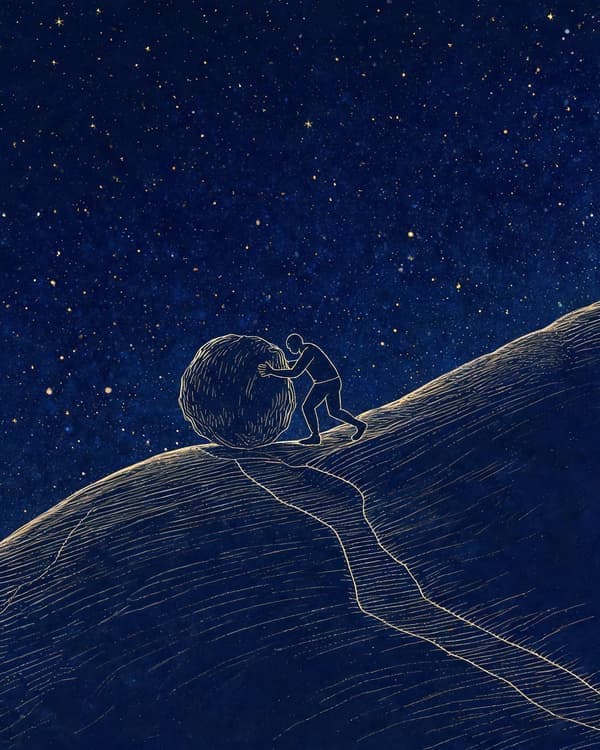
Rebellion is the positive face of this stance. To say no to the absence of meaning is already to affirm something—the value of the struggle, of clarity, of human solidarity within a world that does not answer. The absurd hero is Sisyphus, condemned by the gods to roll a stone up a mountain for eternity, only to watch it roll back down. Camus imagines him during the descent, conscious of his fate and yet not defeated: "The struggle itself toward the heights is enough to fill a man's heart." The point is not that suffering vanishes, but that lucid acceptance transfigures it into revolt. Freedom here means freedom from the future and from hope, intensifying the present rather than mortgaging it to a promised hereafter.
Absurdism must be distinguished from nihilism and existentialism, though the borders are contested. Nihilism holds that nothing has value or meaning; absurdism does not deny value but locates it in lucid living rather than in a metaphysical guarantee. Existentialism, especially in Sartre, tends to treat freedom and choice as the ground on which meaning is created. Camus resisted this move, arguing that the absurd cannot be overcome by an act of will and that any philosophy that leaps beyond it has betrayed it.
Key Thinkers
Albert Camus is the central figure of absurdism, and his The Myth of Sisyphus, The Stranger, The Plague, and Caligula form its core corpus. His relationship to Jean-Paul Sartre and the existentialist circle was one of mutual influence and eventual public rupture, which helps mark the boundary between the two positions. Earlier thinkers—Kierkegaard, Nietzsche, Chestov, Jaspers, and Husserl—appear in Camus's essay as figures who confronted the absurd but, in his reading, then leapt beyond it toward faith or transcendence. Later writers in literature and theater extended the sensibility without always preserving its philosophical precision.
Influence
Absurdism shaped twentieth-century literature, theater, and philosophy. The Theater of the Absurd—associated with Samuel Beckett, Eugène Ionesco, and Arthur Adamov—dramatized a world in which conventional meaning had broken down, though Camus himself was skeptical of the label and of purely nihilistic readings of his work. In philosophy, absurdism entered debates about meaning, secular ethics, and the limits of metaphysical consolation, and it remains a touchstone for discussions of how to live without transcendence. Its vocabulary circulates widely in popular culture, where it is often reduced to a fashionable despair. Its real force lies elsewhere: in the steadiness of a refusal to take refuge in either despair or illusion, and in the claim that a life without guaranteed meaning can still be lived with lucidity, passion, and revolt.
Sources
- Stanford Encyclopedia of Philosophy, "Albert Camus."
- Internet Encyclopedia of Philosophy, "Albert Camus."
- Albert Camus, The Myth of Sisyphus and Other Essays, trans. Justin O'Brien (Vintage Books, 1955).
Learning Path
Part of a Structured Collection
Understanding Yourself
A learning path through self-knowledge, identity, wisdom, and practical discernment — from Socrates to modern philosophy.
Continue learning path →
Life Questions
A learning path through enduring questions of happiness, meaning, purpose, fear, courage, and living well.
Continue learning path →
Continue Learning
Knowledge NetworkNext Step
Continue your learning path
- answer
Nihilism vs Absurdism vs Existentialism — What's the Difference?
Related through Absurdity
- wisdom
Absurdity
Related through Meaning
- thinker
Albert Camus
Related through Absurdity
- quote
One Must Imagine Sisyphus Happy
Related through Absurdity
- book
The Myth of Sisyphus
Related through Absurdity
- quote
Camus: One Must Imagine Sisyphus Happy
Related through Absurdity
- answer
Sartre vs Camus — What's the Difference?
Related through Absurdity
- topic
Meaning in Life
Related through Meaning
Archive references
Sources
- 01Albert CamusBy Stanford Encyclopedia of PhilosophyConsult source
- 02Albert CamusBy Internet Encyclopedia of PhilosophyConsult source
- 03The Myth of Sisyphus and Other EssaysBy Albert Camus, translated by Justin O'BrienNew York: Vintage Books, 1955.
ZHAIBIAN Editorial Board reviewed
Reviewed by ZHAIBIAN AI Editorial Review · 2026-07-30