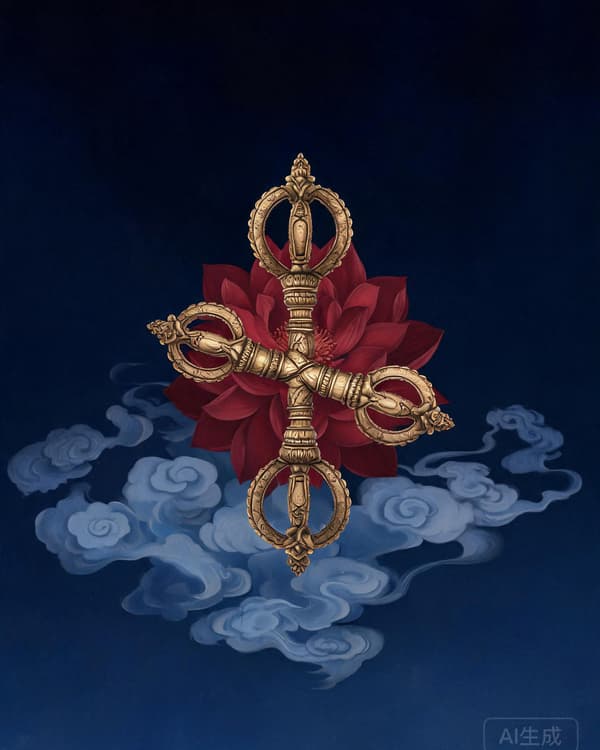
Overview
Origin
Tibet (7th century CE onward)
Founded period
Historical tradition
Important figures
Padmasambhava · Atisha · Tsongkhapa
Major texts
Tibetan Book of the Dead
Concept archive
Core Principles
PRINCIPLE 01
Vajrayana
PRINCIPLE 02
tantra
PRINCIPLE 03
deity yoga
PRINCIPLE 04
lamrim
PRINCIPLE 05
emptiness and compassion
People in this tradition
Important Figures
Dalai Lama
An evidence-led introduction to the 14th Dalai Lama, Tenzin Gyatso — his life, teachings on compassion and secular ethics, and his role as the global face of Tibetan Buddhism.
Tsongkhapa
An evidence-led introduction to Tsongkhapa, the 14th-century Tibetan philosopher who founded the Gelug school and wrote the definitive commentaries on Madhyamaka philosophy.
Shantideva
A historically careful introduction to Shantideva, the Indian Mahayana Buddhist philosopher and author of the Bodhicaryavatara on the bodhisattva path and compassion.
Primary and related texts
Related Books
Tibetan Buddhism
Overview
Tibetan Buddhism is the form of Buddhism that developed in Tibet from the 7th century onward, drawing on the Mahayana and Vajrayana traditions of India. It combines the scholastic rigor of Indian Buddhist philosophy with tantric methods of meditation and ritual, producing a tradition that is at once intellectually demanding and richly devotional. If you want to understand Tibetan Buddhism, you need to grasp that it is not a separate religion from Buddhism — it is Buddhism as it evolved in the specific cultural and political soil of the Himalayas.
The tradition is organized into four major schools: Nyingma (the oldest, tracing its origins to Padmasambhava in the 8th century), Kagyu (known for its meditation lineage and the institution of the Karmapa), Sakya (whose scholars produced key works on Buddhist logic), and Gelug (the school of the Dalai Lamas, founded by Tsongkhapa in the 14th century). Each school preserves its own set of teachings and transmissions, but they all share the same core — the Vajrayana path.
Core Teachings
Vajrayana, the "diamond vehicle," is what makes Tibetan Buddhism distinctive. The name suggests something that cuts through and cannot be destroyed. Vajrayana builds on Mahayana philosophy — emptiness, bodhicitta, the bodhisattva path — but adds tantric methods designed to accelerate the journey to awakening. These include deity yoga, in which the practitioner visualizes themselves as a buddha or bodhisattva, and the use of mantras, mudras, and mandalas as tools for transforming ordinary perception into awakened awareness.
The philosophical backbone remains the Madhyamaka school, particularly the Prasangika interpretation associated with Nagarjuna and refined by Tsongkhapa. The key claim is that all phenomena are empty of inherent existence — not because they do not exist, but because they exist dependently, as interdependent arisings. What Vajrayana adds is not a new metaphysics but a new method: instead of gradually working toward insight over many lifetimes, the tantric practitioner uses the raw materials of experience — desire, emotion, even the states of consciousness at the time of death — as the path itself.
The lamrim, or "stages of the path," is the pedagogical framework that organizes these teachings into a progressive sequence. Atisha introduced it in the 11th century, and Tsongkhapa elaborated it into its definitive form. The practitioner begins with renunciation, moves through compassion and bodhicitta, and arrives at the wisdom of emptiness — all while engaging in tantric practice under qualified guidance.
Historical Context
Buddhism entered Tibet during the reign of King Songtsen Gampo in the 7th century, but it was Padmasambhava, invited by King Trisong Detsen in the 8th century, who is credited with establishing it firmly. The Nyingma school traces its lineage to him. A second wave of transmission in the 10th and 11th centuries, led by figures like Atisha and the translator Marpa, produced the "new translation" schools — Kagyu, Sakya, and later Gelug.
The Gelug school, founded by Tsongkhapa (1357–1419), became the dominant political and religious force in Tibet. The office of the Dalai Lama, held by successive reincarnations recognized within the Gelug tradition, became the political leadership of Tibet from the 17th century until the Chinese takeover in 1959. The 14th Dalai Lama, Tenzin Gyatso, has been the most visible representative of Tibetan Buddhism on the world stage.
Philosophical Interpretation
The central philosophical claim of Tibetan Buddhism is not different from Nagarjuna's: all phenomena are empty of inherent existence. What Tibetan scholasticism contributes is an extraordinarily detailed analysis of what that means in practice. Tsongkhapa's works, especially the Lamrim Chenmo (Great Treatise on the Stages of the Path), are considered definitive. They argue that the correct understanding of emptiness is not a blanket negation but a precise denial of inherent existence while affirming conventional reality.
Vajrayana practice adds a distinctive twist. If all phenomena are empty, then there is no fixed difference between the ordinary mind and the awakened mind — the difference is only in recognition. Deity yoga exploits this: by visualizing yourself as a fully awakened deity, you are not pretending to be something you are not. You are recognizing what, in a sense, you already are. The practice works because the emptiness of the self means the self is not a fixed thing but a dependently arisen process that can be transformed.
Modern Relevance
Tibetan Buddhism has had enormous influence beyond Tibet, especially since the diaspora following 1959. The Dalai Lama's teachings on compassion and secular ethics have reached a global audience. Mindfulness practices derived from Tibetan lojong (mind training) have entered mainstream psychology. The tradition's approach to death and dying, preserved in the Tibetan Book of the Dead, has influenced contemporary conversations about end-of-life care.
The political situation of Tibet remains unresolved, and the future of the tradition in its homeland is uncertain. But the teachings have taken root in centers and monasteries around the world, and the philosophical and contemplative resources of Tibetan Buddhism continue to be studied and practiced with an intensity that would have been hard to imagine a century ago.
Related Learning
- The Tsongkhapa thinker page covers the founder of the Gelug school.
- The Dalai Lama page details the 14th Dalai Lama's life and teachings.
- The Tibetan Book of the Dead is the tradition's most famous text.
- The Buddhism philosophy page provides the broader Mahayana framework.
Sources
- "Tibetan Buddhism." Stanford Encyclopedia of Philosophy. https://plato.stanford.edu/entries/tibetan-buddhism/
- "Vajrayana Buddhism." Internet Encyclopedia of Philosophy. https://iep.utm.edu/bud-vaja/
- Coleman, Graham, trans., with Thupten Jinpa. The Tibetan Book of the Dead. New York: Viking, 2005.
Continue Learning
Knowledge NetworkDeep Dive
Explore related concepts
- collection
Eastern Philosophy
Related through Buddhism
- thinker
Dalai Lama
Related through Buddhism
- thinker
Tsongkhapa
Related through Buddhism
- philosophy
Mahayana Buddhism
Related through Buddhism
- book
Tibetan Book of the Dead
Related through Buddhism
- thinker
Shantideva
Related through Buddhism
- answer
What Is Emptiness?
Related through Buddhism
- topic
Mindfulness
Related through Buddhism
Archive references
Sources
- 01Tibetan BuddhismBy Stanford Encyclopedia of PhilosophyConsult source
- 02Buddhism: Vajrayana BuddhismBy Internet Encyclopedia of PhilosophyConsult source
- 03The Tibetan Book of the DeadBy translated by Graham Coleman with Thupten JinpaNew York: Viking, 2005.
ZHAIBIAN Editorial Board reviewed
Reviewed by ZHAIBIAN AI Editorial Review · 2026-08-08