Overview
Origin
Athens, circa 5th-4th century BCE; founded by Antisthenes
Founded period
Historical tradition
Important figures
Antisthenes · Diogenes of Sinope
Major texts
See related archive records
Concept archive
Core Principles
PRINCIPLE 01
Virtue as the sole good
PRINCIPLE 02
Living according to nature
PRINCIPLE 03
Ascetic self-sufficiency
PRINCIPLE 04
Shamelessness and frank speech
PRINCIPLE 05
Rejection of convention
People in this tradition
Important Figures
Aristotle
An evidence-led introduction to Aristotle, the fourth-century BCE Greek philosopher whose work shaped ethics, logic, metaphysics, and accounts of human flourishing.
Epictetus
An evidence-led introduction to Epictetus, Stoic philosopher and teacher whose Discourses and Enchiridion shaped Western thought on freedom, discipline, and the examined life.
Cynicism
Meaning and Origins
Cynicism is an ancient Greek philosophical school that flourished from the late fifth century BCE through the Hellenistic period. Its name derives from the Greek kynikos, meaning "dog-like," a label its adherents accepted and even embraced. The Cynics held that virtue is the only genuine good, that happiness consists in living according to nature rather than convention, and that the trappings of civilization—wealth, fame, political power, social status—are not merely unnecessary but actively corrosive of the good life. To live well, on the Cynic view, is to strip existence down to what nature requires and to meet every other demand with frank indifference.
The school emerged in Athens during a period of profound social upheaval. The Peloponnesian War had exposed the fragility of imperial ambition, the sophists had relativized traditional morality, and Socrates had demonstrated that the examined life demanded relentless questioning of custom. The Stanford Encyclopedia of Philosophy notes that Cynicism grew directly from the Socratic tradition: Antisthenes, the school's founder, was a devoted follower of Socrates, and the Cynics regarded themselves as preserving the master's authentic ethical message after his execution. What they took from Socrates was the conviction that virtue is sufficient for happiness and that most of what people pursue—riches, reputation, luxury—has nothing to do with genuine well-being.
What distinguished the Cynics from other Socratic heirs was the radicalism of their practice. Where Plato retreated into theory and the Academy, the Cynics insisted that philosophy was not a body of doctrines but a way of life demonstrated in action. They took Socrates' austerity and pushed it to an extreme, cultivating poverty, homelessness, and deliberate shamelessness as both personal discipline and public witness. The Cynic was not merely a teacher but a living argument, and the streets of Athens served as the classroom in which that argument was staged.
Key Thinkers
Antisthenes
Antisthenes (c. 445-365 BCE) is the figure in whom Cynicism originates. Born to an Athenian father and a Thracian mother, he was a follower of Socrates who, after the master's death, established his own school at the Cynosarges, a gymnasium outside Athens reserved for those of mixed or foreign birth. This marginal setting suited a man who held that virtue could be taught and that it required nothing beyond what was available to the poorest citizen. Antisthenes wrote prolifically, though his works survive only in fragments. He argued that virtue is a matter of action rather than argument, that the wise person is self-sufficient, and that hardship is a good to be cultivated rather than avoided. The Internet Encyclopedia of Philosophy describes him as the bridge between Socratic ethics and the fully developed Cynic way of life, the thinker who translated Socrates' personal austerity into a philosophical program.
Diogenes of Sinope
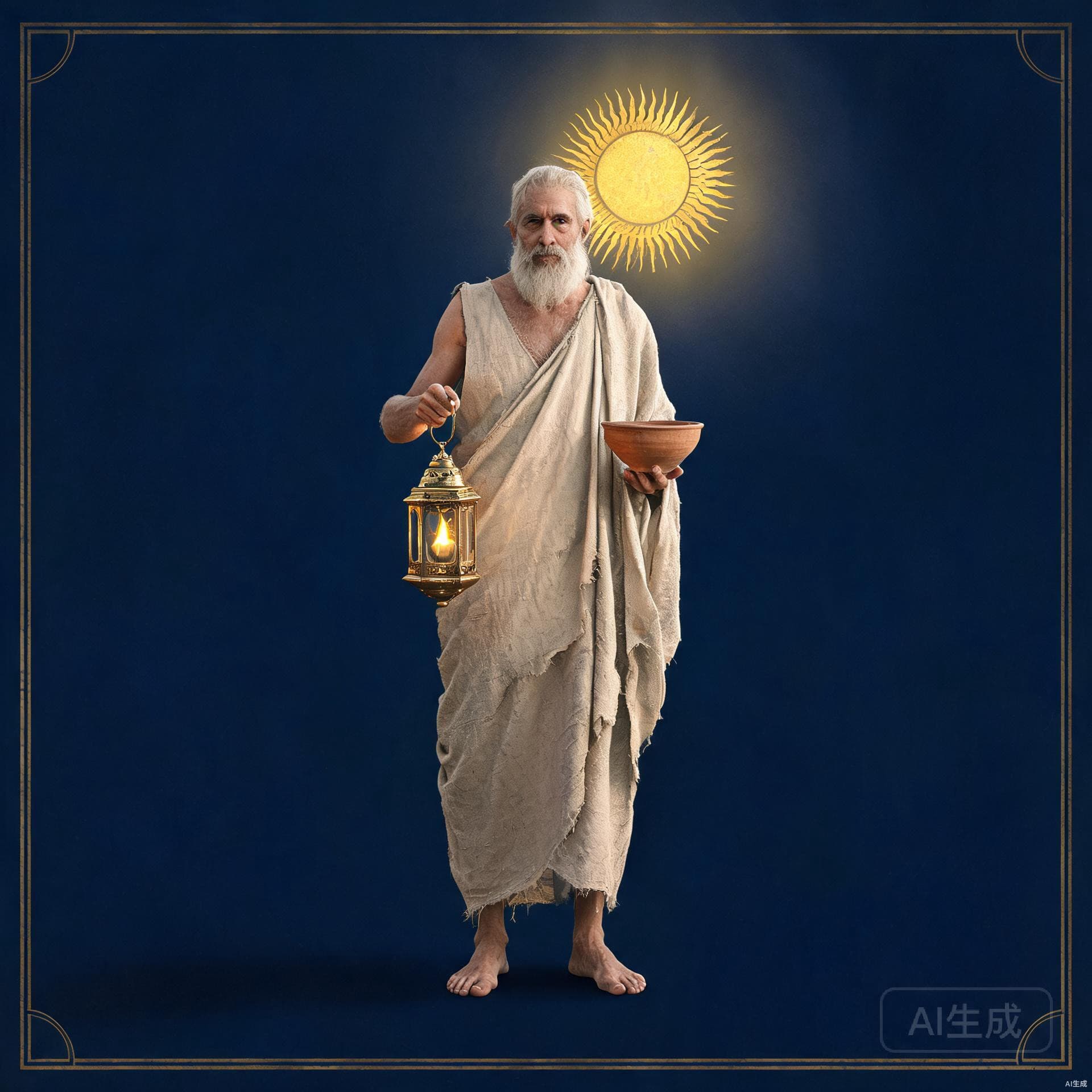
Diogenes of Sinope (c. 412-323 BCE) is the Cynic whose fame eclipsed all others and whose name became virtually synonymous with the school. Exiled from his native Sinope—tradition says for defacing or adulterating currency—he arrived in Athens and adopted the Cynic life with a theatrical completeness that made him legendary. He lived in a clay jar or tub, begged for a living, and dispensed with every convention of decency. The stories that circulated about him are numerous and often apocryphal, but their cumulative portrait is consistent: a man who walked the streets in daylight with a lit lantern, explaining that he was looking for an honest human being; who told Alexander the Great to stop blocking his sunlight; who ate, slept, and performed in public the acts that custom demanded be hidden. Diogenes' significance lies not in systematic philosophy—he wrote little that survives—but in the embodied demonstration that happiness requires none of the things people spend their lives chasing. His life was the argument.
Crates of Thebes
Crates of Thebes (c. 365-285 BCE) succeeded Diogenes as the leading Cynic and softened the school's harshness without abandoning its core. Born to wealth, he gave away his fortune to live as a beggar, and he married Hipparchia, herself a committed Cynic and one of the few women recognized as a philosopher in the ancient record. Crates was known for his gentleness and humor, qualities that made Cynicism accessible where Diogenes' abrasiveness had alienated. The Stanford Encyclopedia emphasizes his role in transmitting Cynic influence to the Stoic tradition: Zeno of Citium, the founder of Stoicism, studied under Crates before developing his own school, and the line from Cynic austerity to Stoic discipline runs directly through him. Crates represents the Cynic as constructive citizen rather than pure provocateur, a teacher whose poverty was a gift to others rather than a solitary protest.
Core Principles
The Cynic school rests on a small set of interlocking commitments, each of which follows from the conviction that virtue alone is sufficient for happiness. These principles are less a theoretical system than a practical ethic, and the Cynics believed they could be verified not by argument alone but by living them.
Virtue as the Sole Good
The first principle is that virtue—and virtue alone—is good. Wealth, reputation, pleasure, health, and strength are, in the Cynic vocabulary, "indifferents": things that may be preferred or dispreferred but cannot make a person better or worse in the only sense that matters. This inheritance from Socrates placed the Cynics in direct opposition to the common-sense view that happiness depends on external goods, and it committed them to the demanding claim that a person stripped of everything could still be happy, provided they possessed virtue. The Stanford Encyclopedia traces this claim through the Cynics to the Stoics, who systematized the distinction between good, bad, and indifferent into a rigorous ethical framework.
Living According to Nature
The second principle is the injunction to live according to nature. For the Cynics, nature meant the bare requirements of human existence—food, shelter, clothing, and warmth in their simplest forms—and convention meant everything that civilization had piled on top of these needs: luxury, fashion, social hierarchy, the pursuit of wealth. The Cynic sought to peel convention away and meet life with only what nature demanded. Diogenes demonstrated this by discarding his cup when he saw a child drink from cupped hands, and by discarding his bowl when he saw a child eat from a hollowed piece of bread, reasoning that he had been carrying unnecessary baggage. The principle was not romantic primitivism but a method of distinguishing the necessary from the superfluous, so that desire could be reduced to what is easy to satisfy and freedom from want could be secured.
Ascetic Self-Sufficiency
The third principle is self-sufficiency (autarkeia), the condition of needing nothing from others that one cannot provide oneself. The Cynics practiced askesis, or disciplined training, to harden the body against cold, hunger, and discomfort, so that fortune could not threaten what one required. Diogenes rolled in hot sand in summer and embraced snow-covered statues in winter to inure himself to hardship. The point of this training was not suffering for its own sake but the cultivation of an unshakable independence: a person who has learned to need almost nothing cannot be harmed by the loss of possessions, status, or comfort. This ideal of self-sufficiency became central to later Hellenistic ethics, and the Internet Encyclopedia notes its particular influence on Stoic accounts of the sage who remains unmoved by external events.
Shamelessness and Frank Speech
The fourth principle is anaideia, sometimes translated as shamelessness or impudence, and parrhesia, frank or fearless speech. The Cynics performed in public the bodily functions that custom demanded be concealed, not out of vulgarity but as a philosophical statement: what nature has given should not occasion shame, and the conventions that govern such things are arbitrary. Their frank speech extended to social criticism. Cynics rebuked politicians, mocked the powerful, and interrupted public gatherings to challenge the values of their audiences. Diogenes was called a dog because he snapped at those who displeased him, and the label stuck. This commitment to speaking truth without regard for consequence gave the Cynics their characteristic voice and made them both admired and reviled.
Historical Development
Cynicism's influence extended far beyond the original circle of Diogenes and his immediate successors. In the Hellenistic period, the school spread throughout the Greek-speaking Mediterranean, and Cynic preachers (diatribe) became a familiar presence in the streets and marketplaces of cities from Antioch to Rome. These later Cynics often combined philosophical teaching with popular moralizing, and the Cynic style of direct address, vivid example, and satirical wit shaped the literary form known as the diatribe, which influenced Roman moralists such as Musonius Rufus, Epictetus, and the satirists Lucian and Juvenal.
The most consequential line of Cynic influence runs to Stoicism. Zeno of Citium, as noted, studied under Crates of Thebes, and the early Stoics adopted the Cynic insistence that virtue is the only good, the distinction between genuine goods and mere indifferents, and the ideal of living according to nature. Where the Cynics made these commitments the whole of philosophy, the Stoics incorporated them into a broader system that included logic and physics, and they softened the Cynic demand for total poverty into a more accommodating ethic of moderation. The Stanford Encyclopedia observes that Stoicism is in many respects Cynicism domesticated—a version of the same ethical vision adapted to the lives of citizens, householders, and statesmen rather than wandering ascetics.
Cynicism also left its mark on early Christianity. The wandering preachers of the early church, who owned nothing and depended on charity, bore a structural resemblance to Cynic missionaries, and patristic writers sometimes compared Christian asceticism to Cynic poverty. The Cynic ideal of self-sufficiency and indifference to worldly goods resonated with monastic traditions that took shape in late antiquity, even as the theological frameworks that supported those traditions differed sharply from Cynic naturalism.
In the Roman imperial period, Cynicism enjoyed a revival as a living philosophical practice. Figures such as Demetrius, a Cynic admired by Seneca, and Peregrinus Proteus, who immolated himself at the Olympic games, kept the school's provocative tradition alive. The Cynic emphasis on moral freedom and contempt for convention appealed in an age when political participation was constrained and the consolations of philosophy were in demand. The school persisted in various forms into late antiquity before being absorbed, along with other pagan traditions, into the intellectual synthesis of Neoplatonism and the institutional structures of Christian thought.
Modern Influence
The modern word "cynicism" bears only a faint relation to the ancient school. In contemporary usage, a cynic is someone who distrusts the motives of others and expects the worst from human conduct—a posture of suspicion rather than a philosophy of virtue. This semantic drift began in late antiquity and the Renaissance, when the Cynics' criticism of convention was reinterpreted as mere contempt for humanity, and it accelerated in the modern period until the philosophical meaning was largely displaced. The Stanford Encyclopedia cautions against conflating the two: ancient Cynicism was an ethical program aimed at happiness through virtue, not a temperament of disillusionment.
In philosophy proper, the Cynic tradition has resurfaced at several points. Renaissance humanists recovered the classical accounts of Diogenes and treated the Cynic life as a model of moral independence against the corruptions of courtly society. Nietzsche admired the Cynics as among the few ancient thinkers honest enough to say what they meant, and he credited Diogenes with a intellectual probity that he found lacking in more respectable schools. Michel Foucault, in his late lectures on the "care of the self," returned to Cynicism as a paradigm of philosophy as a form of life, a practice of truth-telling in which the philosopher's existence itself becomes the site of critique. For Foucault, the Cynic practice of living otherwise—of making one's life a counter-example to the prevailing order—represented a permanent possibility within the philosophical tradition, one that challenged the boundary between thought and existence.
The Cynic legacy also survives in less formal ways. The figure of the truth-teller who refuses comfort and convention to expose hypocrisy recurs in literature and popular culture, from the holy fools of Russian fiction to the satirists and gadflies of modern public life. The Cynic insistence that happiness does not require what society insists one must have speaks directly to contemporary anxieties about consumption, status, and the accelerating demands of modern economies. A tradition that began with a man living in a jar and telling the most powerful conqueror of his age to step out of his light continues to pose a question that has lost none of its force: how much of what we pursue do we actually need, and what would our lives look like if we dared to find out?
Key Ideas
The Cynic school condenses into a handful of ideas that, despite their antiquity, remain philosophically provocative. The first is that the gap between what we want and what we need is the space in which most human misery is manufactured, and that closing this gap is the direct route to freedom. The second is that virtue is demonstrated in action rather than affirmed in doctrine, and that the philosopher who cannot live their philosophy has not yet understood it. The third is that convention is not nature, and that the courage to violate convention is the precondition of seeing clearly what a good life requires. The fourth is that self-sufficiency is not isolation but the condition of genuine generosity: only the person who needs nothing can give without calculation and speak without fear.
These ideas place Cynicism in a distinctive relation to the other schools of ancient ethics. Like the Epicureans, the Cynics sought a life free from disturbance, but where Epicurus located tranquility in moderate pleasure and friendship, the Cynics located it in the radical reduction of need. Like the Stoics, the Cynics held that virtue suffices for happiness, but where the Stoics built a comprehensive system of logic, physics, and ethics, the Cynics trusted the example of a life lived in public. And like Socrates himself, the Cynics treated philosophy as a practice of examination that could not be separated from the conduct of the examiner. The Cynic contribution to the history of thought is less a set of arguments than a sustained demonstration that the examined life, taken seriously, will look strange to the world that has not examined itself.
What gives the Cynic tradition its peculiar staying power is the simplicity of its challenge. It does not ask a person to master a complex doctrine or to accept a difficult metaphysics. It asks them to consider whether the things they have been taught to want are worth wanting, and whether the life they have been taught to admire is worth living. The Cynics did not expect most people to follow them into the tub, and they did not pretend that their way was easy. What they offered was a standard against which every other life could be measured, and a reminder that the freedom people seek through accumulation is more reliably found through subtraction. In an age that has multiplied human wants far beyond anything the ancient world could have imagined, the Cynic question—how much of this is necessary?—retains a force that no technological advance has diminished.
Sources
- Stanford Encyclopedia of Philosophy, "Cynicism." A comprehensive scholarly treatment of the school's origins, figures, doctrines, and influence on Stoicism and later thought.
- Internet Encyclopedia of Philosophy, "Cynics." An accessible overview of Cynic ethics, practice, and the distinction between ancient and modern uses of the term.
- Internet Encyclopedia of Philosophy, "Diogenes of Sinope." A focused study of the school's most famous practitioner and the legends that surround him.
Continue Learning
Knowledge NetworkDeep Dive
Explore related concepts
- answer
What Is Cynicism?
Related through Virtue
- collection
Ancient Wisdom
Related through virtue
- thinker
Aristotle
Related through virtue
- topic
The Good Life
Related through virtue
- wisdom
Virtue
Related through virtue
- thinker
Epictetus
Direct archive relation
- topic
Philosophy of Life
Direct archive relation
- wisdom
Simplicity
Direct archive relation
Archive references
Sources
- 01CynicismBy Stanford Encyclopedia of PhilosophyConsult source
- 02CynicsBy Internet Encyclopedia of PhilosophyConsult source
- 03Diogenes of SinopeBy Internet Encyclopedia of PhilosophyConsult source
ZHAIBIAN Editorial Board reviewed
Reviewed by ZHAIBIAN AI Editorial Review · 2026-08-04