Archive navigation
Knowledge Path
Thinker
Aristotle
Philosophy
Quotation archive
Selected Quotes
“The human good proves to be activity of soul in accordance with virtue, and if there are several virtues, in accordance with the best and most complete virtue.”
“We become just by doing just actions, temperate by doing temperate actions, courageous by doing courageous actions.”
“Happiness is the best, noblest, and most pleasant thing, and these qualities are not separated as the Delian inscription suggests.”
“Man is by nature a political animal, and a man who is by nature and not merely by fortune citiless is either superior or inferior to man.”
“We become just by doing just acts, temperate by doing temperate acts, brave by doing brave acts.”
“Sapere aude! Have the courage to use your own understanding.”
“Two things fill the mind with ever new and increasing admiration and awe: the starry heavens above me and the moral law within me.”
“There is radically evil in human nature; this is undeniable.”
“The unexamined life is not worth living for a human being.”
“And now, I said, let me show in a figure how far our nature is enlightened or unenlightened: Behold! human beings living in an underground den, and at the entrance a fire.”
“Until philosophers rule as kings or those who are now called kings and leading men genuinely and adequately philosophize, that is, until political power and philosophy entirely coincide... cities will have no rest from evils.”
“Virtue is a mean between two vices, one of excess and the other of deficiency.”
“Friendship is a virtue or involves virtue, and is besides most necessary for our life.”
“Contemplation is the highest activity of the human soul, and the one that brings the most perfect happiness.”
“We become just by doing just actions, temperate by doing temperate actions, brave by doing brave actions.”
“All men by nature desire to know.”
“Do not impose on others what you yourself do not desire.”
“From the Son of Heaven down to the common people, all must consider the cultivation of the person the root of all things.”
“Act only according to that maxim through which you can at the same time will that it should become a universal law.”
“So act that you use humanity, whether in your own person or in the person of any other, always at the same time as an end, never merely as a means.”
“A virtue is an acquired human quality the possession and exercise of which tends to enable us to achieve those goods which are internal to practices and the lack of which effectively prevents us from achieving any such goods.”
“It is better to be a human being dissatisfied than a pig satisfied; better to be Socrates dissatisfied than a fool satisfied. And if the fool, or the pig, are of a different opinion, it is because they only know their own side of the question.”
“Justice is the first virtue of social institutions, as truth is of systems of thought. A theory however elegant and economical must be rejected or revised if it is untrue; likewise laws and institutions no matter how efficient and well-arranged must be reformed or abolished if they are unjust.”
Biography
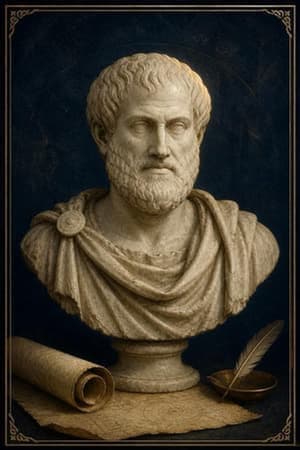
Aristotle was born in 384 BCE at Stagira in northern Greece and died in 322 BCE. Ancient biographical traditions connect his early life to Macedon: his father, Nicomachus, served as physician to King Amyntas III. The surviving evidence for Aristotle's life is incomplete, and later biographies contain legendary material. What is secure is that he became one of antiquity's most influential philosophers and that a large body of works associated with his school survives.
Aristotle studied at Plato's Academy in Athens for many years. After Plato's death, he spent time in Asia Minor and Lesbos, later returned to Macedon, and eventually founded or directed a school in Athens known as the Lyceum. The school came to be called Peripatetic, a name connected with its practice of walking or with the covered walkways of the Lyceum. Aristotle's writings range across logic, natural inquiry, metaphysics, ethics, politics, rhetoric, poetry, and the study of living things.
Historical Context
Aristotle worked in the fourth century BCE, a period of political transformation in the Greek world. The city-states that had framed earlier Athenian philosophy existed alongside the expanding power of Macedon. His thought inherits questions from Plato, Socrates, Presocratic natural philosophy, medical inquiry, and public debate, while developing approaches that are often more systematic and empirical in orientation.
The texts now read under Aristotle's name were not composed as one uniform library for a modern public. Many have the character of lecture materials or research notes connected with the Lyceum. Their transmission, organization, and interpretation therefore require scholarly care. They should not be treated as direct transcripts of a single moment in Aristotle's life.
Core Ideas
Aristotle asks what it is for a thing to be what it is, how explanation works, how living beings develop, and how human beings should live. His account of explanation is commonly associated with four kinds of cause: material, formal, efficient, and final. His ethics centers on eudaimonia, often translated as happiness or flourishing, and asks what activities and traits belong to a life lived well.
Virtue is central to this inquiry. Moral virtue is not merely a rule or a feeling; it is a settled disposition to choose well, developed through practice, education, and judgment. Aristotle also distinguishes practical wisdom, which concerns deliberating well about action, from theoretical forms of knowledge. These distinctions remain influential but are debated, especially where Aristotle's account depends on social assumptions of his own time.
Philosophy
Aristotle's philosophy is not one isolated doctrine. In logic he developed tools for analyzing argument; in metaphysics he examined substance, change, potentiality, and actuality; in natural philosophy he studied motion and living things; in ethics and politics he connected character to shared forms of life. Modern scholarship disputes how tightly these domains fit together, but they share an interest in explanation that attends to the kind of thing under investigation.
His teleological language is especially important. Aristotle often explains an activity or capacity by reference to its end or characteristic work. In ethics, this supports his question about the human good. It does not license a simple claim that every historical institution or inequality is natural; Aristotle's own political judgments are subject to serious criticism, including his defenses of hierarchy and slavery.
Major Works
Works associated with Aristotle include the Categories, On Interpretation, Prior Analytics, Physics, Metaphysics, On the Soul, Nicomachean Ethics, Politics, Rhetoric, and Poetics. The corpus also includes biological investigations and texts whose authorship or final form has been debated. Reading any one work requires attention to genre, textual history, and translation.
The Nicomachean Ethics is particularly important for this archive because it examines happiness, virtue, friendship, pleasure, and practical reasoning. It is not a self-help manual and does not reduce ethical life to private satisfaction. Its questions concern what a complete human life requires and how character is formed through action.
Nicomachean Ethics
The Nicomachean Ethics begins with the question of the highest good pursued in action. Aristotle identifies this end with eudaimonia, a term whose ordinary English translation as “happiness” can be misleading if it suggests a passing emotion. The Stanford Encyclopedia of Philosophy describes the term as connected with living well and as the highest end for which subordinate goods are pursued.
Aristotle's discussion moves through virtue, voluntary action, deliberation, justice, friendship, pleasure, and contemplation. It also recognizes that ethical activity needs some external conditions. This makes the account more complex than the claim that virtue alone guarantees a good life, while still giving virtue a central role.
Virtue Ethics
Aristotle is a foundational figure for virtue ethics, though contemporary virtue ethics is not identical with his thought. His moral virtues concern dispositions such as courage, generosity, justice, and temperance. The often-cited doctrine of the mean does not say that the right action is always a numerical middle. It says that good judgment must find what is appropriate in a particular situation, relative to the person and circumstances.
Practical wisdom is necessary because general rules cannot settle every case. A courageous action differs from recklessness and cowardice not only by quantity of fear but by its object, timing, purpose, and reason. This is why Aristotle's account of virtue connects character to perception, deliberation, and habituation.
Happiness and Human Flourishing
Aristotle's account of happiness is an account of a whole life rather than a momentary feeling. A happy person, in the relevant sense, exercises capacities excellently and develops the virtues appropriate to human life. Friendship, participation in a community, and the conditions for sustained activity are also significant in his inquiry.
This framework has influenced modern discussions of well-being, education, and human capabilities. It also raises difficult questions: whose opportunities count, which social conditions enable flourishing, and whether Aristotle's ideals can be separated from exclusions built into ancient Greek civic life. A careful use of Aristotle preserves both the power of the question and the need for criticism.
Influence Today
Aristotle's influence reaches medieval Islamic, Jewish, and Christian philosophy; early modern science; modern virtue ethics; political theory; and contemporary debates about well-being. His analyses of explanation and living things have been reassessed in light of modern science, while his ethical vocabulary of flourishing, virtue, practical wisdom, and friendship remains active.
Contemporary readers often encounter Aristotle through simplified claims about “finding the mean” or “being happy.” The archive instead treats his work as a demanding investigation of character, institutions, reasoning, and the conditions of a life lived well.
Famous Quotes
This entry does not present detached Aristotle quotations. Many popular sayings attributed to Aristotle cannot be located in his surviving works or vary substantially across translations. Future Quote Archive entries should identify a work, book and section number, and a named translator before presenting any wording as Aristotle's.
Sources
- Stanford Encyclopedia of Philosophy, “Aristotle.”
- Stanford Encyclopedia of Philosophy, “Aristotle's Ethics.”
- Stanford Encyclopedia of Philosophy, “Aristotle's Natural Philosophy.”
- Aristotle, Nicomachean Ethics, trans. Terence Irwin (Hackett, 2019).
Related Thinkers
Aristotle studied in Plato's Academy and developed positions that frequently differ from Plato's. Later Peripatetic thinkers, medieval commentators, and modern virtue ethicists continued to debate his account of explanation and ethical life. The associated records in this archive should be read as relationships and conversations, not as evidence that all later traditions simply repeat Aristotle.
Learning Path
Part of a Structured Collection
Understanding Reality
A learning path through truth, knowledge, reality, and perception — from Plato to existential philosophy.
Continue learning path →
Understanding Yourself
A learning path through self-knowledge, identity, wisdom, and practical discernment — from Socrates to modern philosophy.
Continue learning path →
Ancient Wisdom
A learning path through foundational questions of flourishing, virtue, harmony, duty, and the art of living.
Continue learning path →
Life Questions
A learning path through enduring questions of happiness, meaning, purpose, fear, courage, and living well.
Continue learning path →
A Guide to Stoicism
A structured learning path through Stoic ideas of judgment, virtue, discipline, fear, duty, and inner peace.
Continue learning path →
Continue Learning
Knowledge NetworkNext Step
Continue your learning path
- answer
Aristotle vs Kant: Virtue Ethics vs Duty Philosophy
Related through Greek Philosophy
- topic
Wisdom
Related through Greek Philosophy
- wisdom
The Good Life
Related through Greek Philosophy
- wisdom
Virtue
Related through Greek Philosophy
- book
Nicomachean Ethics
Related through Greek Philosophy
- thinker
Plato
Related through Greek Philosophy
- answer
How Do I Build Character?
Related through Greek Philosophy
- answer
How do I cultivate virtue?
Related through Greek Philosophy
Archive references
Sources
- 01AristotleBy Stanford Encyclopedia of PhilosophyConsult source
- 02Aristotle's EthicsBy Stanford Encyclopedia of PhilosophyConsult source
- 03Aristotle's Natural PhilosophyBy Stanford Encyclopedia of PhilosophyConsult source
- 04Nicomachean EthicsBy Aristotle; translated by Terence IrwinIndianapolis: Hackett, 2019.
ZHAIBIAN Editorial Board reviewed
Reviewed by ZHAIBIAN AI Editorial Review · 2026-07-22