Overview
Origin
Third-century CE Roman Egypt (Alexandria) and Rome
Founded period
Historical tradition
Important figures
Plotinus
Major texts
See related archive records
Concept archive
Core Principles
PRINCIPLE 01
The One (to hen)
PRINCIPLE 02
Emanation (proodos)
PRINCIPLE 03
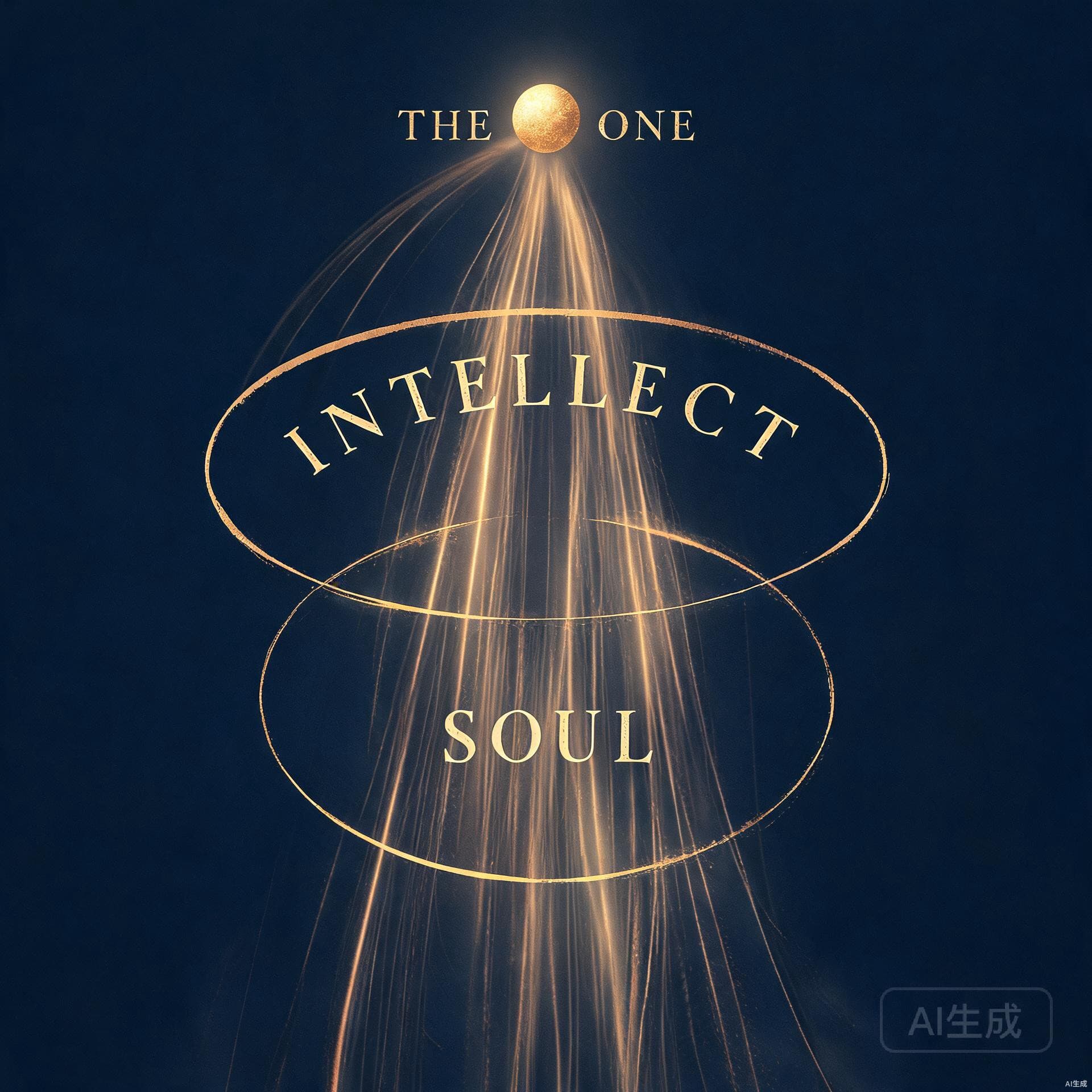
The hypostases (One, Intellect, Soul)
PRINCIPLE 04
The return (epistrophe)
PRINCIPLE 05
Theurgy and hierarchical reality
People in this tradition
Important Figures
Plotinus
Plotinus was the founder of Neoplatonism, teaching that all reality emanates from a transcendent One through Nous and Soul, and that the soul returns to the One through contemplation and mystical union.
Augustine of Hippo
Augustine of Hippo (354-430) was a North African bishop and philosopher whose synthesis of Christian theology with Greek philosophy shaped Western thought for over a millennium.
Meaning and Origins
Neo-Platonism is the name given by modern historians to the last great philosophical movement of classical antiquity. It was founded in the third century CE by Plotinus (c. 204-270), an Egyptian-born philosopher who taught in Rome, and it was developed over the following three centuries by a succession of thinkers who regarded themselves not as innovators but as faithful interpreters of Plato. The movement took Plato's metaphysics, ethics, and theology and wove them into a comprehensive system that also drew on Aristotle's logic and psychology, Stoic epistemology, and Pythagorean mathematics. The result was a unified vision of reality as a graded hierarchy proceeding from a single, ineffable source — the One — through successive levels of being down to the material world, and a corresponding account of the soul's ascent back to its origin.
The term "Neo-Platonism" itself is a modern coinage. It was introduced by eighteenth-century German scholars who wanted to distinguish the later Platonic tradition from Plato's own dialogues. The ancient Neo-Platonists did not call themselves "Neo" anything; they called themselves Platonists, pure and simple, and they believed that their system recovered the true, esoteric teaching that Plato had conveyed orally in the Academy. Modern scholarship has shown that this self-understanding was not entirely fanciful: many of the ideas that the Neo-Platonists systematized — the theory of forms, the immortality of the soul, the ascent toward the Good — are genuinely Platonic. What is distinctively "Neo" is the architectural ambition, the hierarchical ordering of reality, the doctrine of emanation, and the mystical orientation that makes philosophy itself a path of spiritual liberation.
The origins of the movement lie in the intellectual ferment of Alexandria, the great cosmopolitan city where Greek, Egyptian, Jewish, and Christian thought intersected. Plotinus studied there under Ammonius Saccas, a shadowy figure about whom little is known but who also taught Origen, the Christian theologian. This Alexandrian background is significant: Neo-Platonism emerged in a world where philosophical schools were no longer the sole custodians of wisdom, where mystery religions and gnostic sects competed for allegiance, and where the question of how the soul relates to a transcendent God had become urgent. Plotinus's answer — that the entire cosmos is a procession from and return to the One — was both a philosophical argument and a spiritual therapy, designed to lead the mind from the distractions of embodiment to the unity from which it came.
Key Thinkers
Plotinus (c. 204-270)
Plotinus is the founder and towering figure of Neo-Platonism. Born in Egypt, he came to Rome in about 244 CE and established a school that attracted members of the Roman senatorial elite. His philosophy is recorded in the Enneads, a collection of fifty-four treatises edited and arranged by his student Porphyry into six groups of nine (hence the name, from the Greek ennea, "nine"). Plotinus's prose is dense, repetitive, and often visionary; he writes as someone struggling to articulate an experience that lies beyond ordinary language. His central achievement was the articulation of the three hypostases — the One, Intellect (Nous), and Soul (Psyche) — as the fundamental structure of reality, and the demonstration that everything that exists flows from the One through a process of emanation that in no way diminishes or changes its source.
Plotinus insisted that philosophy is not merely an intellectual exercise but a way of life. The goal of the philosopher is to ascend through contemplation to the vision of the One, an experience he describes as a union beyond thought, beyond duality, beyond even self-consciousness. He himself, Porphyry tells us, attained this union four times during the six years Porphyry knew him. This mystical dimension does not make Plotinus an anti-rationalist; his arguments are among the most rigorous in ancient philosophy. But it does mean that for him, reason is ultimately in the service of a transformative insight that reason itself cannot produce.
Porphyry (c. 234-305)
Porphyry of Tyre was Plotinus's most important student and the editor of the Enneads. He was a prolific writer whose surviving works include the Life of Plotinus, the Isagoge (an introduction to Aristotle's Categories that became a standard textbook in the medieval curriculum), the Sententiae (a collection of philosophical aphorisms), and the Letter to Marcella, an ethical work addressed to his wife. Porphyry's contribution to Neo-Platonism was primarily one of systematization and pedagogy: he organized Plotinus's treatises into a coherent curriculum, clarified arguments that Plotinus had left in draft form, and extended the tradition into new areas, including the philosophy of language, the interpretation of Aristotle, and the critique of Christianity. His Against the Christians, now surviving only in fragments, argued that Christian scripture was historically unreliable and philosophically naive — a critique that later Neo-Platonists would refine.
Iamblichus (c. 245-325)
Iamblichus of Chalcis, a student of Porphyry's student Anatolius, shifted Neo-Platonism in a decisively theurgical direction. He argued that the human soul is so deeply embedded in the material world that it cannot ascend to the One by philosophy alone; it requires ritual assistance — theurgy, or "god-working" — to invoke the gods and draw their power down into the soul. This represented a significant departure from Plotinus, who had insisted that the soul retains sufficient autonomy to ascend through its own contemplative effort. For Iamblichus, the hierarchy of reality was far more elaborate than Plotinus's three hypostases: he populated the cosmos with layers of gods, daemons, and heroes, each requiring specific rituals of invocation. His On the Mysteries of the Egyptians became a foundational text for later pagan theology and for the Renaissance revival of magic.
Proclus (c. 412-485)
Proclus, who headed the Platonic Academy in Athens for nearly fifty years, was the most systematic and encyclopedic of the Neo-Platonists. His Elements of Theology presents the entire system as a sequence of propositions and proofs, in conscious imitation of Euclid's geometry. Proclus refined the doctrine of emanation with the triad of remaining, proceeding, and returning (mone, proodos, epistrophe): every level of reality remains in its cause, proceeds from it, and returns to it. He also developed an elaborate theory of negation, arguing that the One can be approached only through negative theology — by saying what it is not — since any positive predicate would impose limitation on what is beyond all limitation. Proclus's system represents the culmination of pagan Neo-Platonism; after his death, the Academy continued for only a few more decades before being closed by the emperor Justinian in 529 CE.
Core Principles
The One
At the summit of Neo-Platonic reality stands the One, also called the Good (echoing Plato's Republic) or simply "the First." The One is not a being among beings, not a thing with attributes, not even a self-conscious mind. It is the absolute unity that is the condition of possibility for everything else. Plotinus's argument for the One proceeds from the observation that every existing thing is a unity of some kind — a living organism, a mathematical object, a concept — and that unity itself cannot be one more thing that happens to be unified. Unity must be prior to the things it unifies. Therefore there must be a first principle that is unity without qualification, beyond being, beyond form, beyond thought.
The One is ineffable. Any statement about it — that it is good, that it is powerful, that it exists — is strictly false, because each predicate introduces a distinction (between the thing and its attribute) that the One, being absolute simplicity, cannot possess. This does not mean that the One is nothing; it is, rather, "beyond being," the superabundant source from which all being flows. Negative theology, the discipline of saying what the One is not, is the only honest form of speech about it. Yet the One is not remote or indifferent: because it is the source of everything, it is present to all things as their origin and goal, and the deepest longing of every soul is to return to it.
Emanation
The doctrine of emanation is Neo-Platonism's most distinctive and influential contribution to metaphysics. Emanation (proodos) is the process by which the One generates the many without being diminished, changed, or acted upon. The classic analogy is that of light radiating from the sun: the light proceeds from the sun continuously, the sun loses nothing by its shining, and the light is both dependent on the sun and distinct from it. Similarly, the One overflows, as it were, and its overflow produces Intellect; Intellect, contemplating the One, produces the Forms and, by its own overflow, produces Soul; Soul, contemplating Intellect, produces the material world. Each level is a diminished image of the level above it, further from the source of unity and therefore more divided, more multiple, more subject to change.
Emanation is necessary, not voluntary. The One does not choose to create; it creates by being what it is, just as the sun shines by being a sun. This distinguishes Neo-Platonism sharply from the biblical doctrine of creation ex nihilo, in which God freely chooses to bring the world into being. It also means that emanation is eternal: there was never a time when the One existed without its emanations, just as there was never a time when fire existed without heat. The cosmos is a perpetual, timeless outpouring of reality from its source.
The process of emanation follows a principle that Proclus would formalize as the triad of remaining, proceeding, and returning. Every emanated reality remains in its cause (the way a thought remains in the mind that thinks it), proceeds from its cause as a distinct entity, and returns to its cause through contemplation. This triadic structure means that the cosmos is not a one-way departure from the One but a circular movement: all things come from the One and, through the activity of contemplation, strive to return to it.
The Return
The return (epistrophe) is the complement of emanation. If the One pours forth reality in a descending cascade, the soul, which is the link between the intelligible and the sensible worlds, has the capacity to reverse the process and ascend. For Plotinus, this ascent proceeds through stages. The soul begins by turning away from the distractions of the body and the external world, recognizing that the beautiful objects of sense are merely images of a higher beauty. It then ascends through the practice of the virtues — which purify the soul from attachment to the body — to the realm of Soul itself, where it discovers the universal principles that govern all life. Higher still, it enters the realm of Intellect, where subject and object are unified in the act of knowing, and where the soul contemplates the Forms directly. Finally, in a moment of mystical union that Plotinus describes with extraordinary intensity, the soul passes beyond Intellect and touches the One itself.
This ascent is not merely intellectual. It involves the whole person — will, emotion, and imagination as well as reason. Plotinus's philosophy is, in this sense, a spiritual discipline as much as a theoretical system. The soul that has attained the vision of the One is transformed: it no longer sees itself as a separate individual but as a participant in the unity that is the ground of all things. Yet this state is not permanent, at least not for the soul still in the body; Plotinus acknowledges that the visionary must return to the world of multiplicity, carrying the memory of unity as a guide for life.
For later Neo-Platonists, especially Iamblichus, the return required theurgical ritual as well as philosophical contemplation. Theurgy was not magic in the trivial sense — it was a sophisticated practice of invocation, using prayers, symbols, and material objects to align the soul with the divine powers that pervade the cosmos. The tension between the philosophical and theurgical approaches to the return is one of the defining debates within the Neo-Platonic tradition.
Historical Development
Neo-Platonism developed in three main centers: Rome, where Plotinus and Porphyry taught; Syria, where Iamblichus established his school; and Athens, where Proclus and his successors maintained the Platonic Academy until its closure in 529 CE. A fourth center, Alexandria, continued the tradition in a more scholastic and less mystical form, producing commentators on Plato and Aristotle — most notably Olympiodorus — who transmitted Neo-Platonic ideas to the Islamic world.
The closing of the Athens Academy in 529 CE by the emperor Justinian is traditionally seen as the end of pagan philosophy in the West, but the story is more complex. Seven Neo-Platonic philosophers, including Damascius, the last head of the Academy, went into exile at the court of the Persian king Khosrow I, and some eventually returned to the Byzantine Empire under terms guaranteeing their freedom to teach. More importantly, Neo-Platonic ideas had already entered the Christian and Islamic intellectual traditions, where they would flourish for another thousand years.
In the Latin West, Augustine was the most important conduit of Neo-Platonic thought. His encounter with "the books of the Platonists" — almost certainly translations of Plotinus and Porphyry by Marius Victorinus — in the years before his conversion was decisive for his intellectual development. Augustine adopted the Neo-Platonic distinction between the intelligible and the sensible, the doctrine that evil is a privation of good rather than a positive force, and the idea that the soul must ascend from the material to the spiritual. He reinterpreted these ideas within a Christian framework, replacing the impersonal One with the personal God of scripture and the doctrine of emanation with the doctrine of creation. The result was a synthesis that would dominate Western theology for centuries.
In the Greek East, the author known as Pseudo-Dionysius — writing in the late fifth or early sixth century and claiming to be Dionysius the Areopagite, a convert of Paul — produced a body of works (The Divine Names, The Mystical Theology, The Celestial Hierarchy) that Christianized Proclus's system with extraordinary thoroughness. The Dionysian corpus became one of the most influential texts of medieval Christianity, shaping the mystical theology of the Greek and Latin churches alike. The negative theology of the Mystical Theology, with its insistence that God is beyond all names and all predicates, is a direct transposition of Proclus's doctrine of the One.
In the Islamic world, the translation movement of the ninth and tenth centuries made Plotinus and Proclus available in Arabic. A paraphrase of the Enneads circulated under the title The Theology of Aristotle, and Proclus's Elements of Theology was translated as the Book of Pure Good. These texts profoundly shaped the philosophical movement known as falsafa, influencing al-Kindi, al-Farabi, and especially Ibn Sina (Avicenna), whose distinction between necessary and contingent existence and whose theory of emanation are recognizably Neo-Platonic. The Sufi tradition of mystical ascent, from al-Ghazali to Ibn Arabi, also drew on Neo-Platonic themes of return to the One.
Influence
The influence of Neo-Platonism on the Western intellectual tradition is difficult to overstate. In the medieval period, the Dionysian corpus ensured that Neo-Platonic ideas permeated both Christian and Islamic theology. In the Latin West, the rediscovery of Aristotle in the twelfth and thirteenth centuries did not displace Neo-Platonism; rather, Aquinas and his contemporaries integrated Aristotelian philosophy with a broadly Neo-Platonic metaphysical framework, preserving the idea of a hierarchy of being and the ascent of the soul.
The Italian Renaissance saw a direct revival of Neo-Platonic thought, centered on Florence under the patronage of the Medici. Marsilio Ficino (1433-1499) translated the complete works of Plato and Plotinus into Latin and produced a systematic Christian Neo-Platonism that influenced art, literature, and philosophy throughout Europe. The Renaissance Neo-Platonists' emphasis on the dignity of the human being, the correspondence between the macrocosm and the microcosm, and the ascent of the soul through love shaped the intellectual culture of the period and left its mark on figures as diverse as Michelangelo, Pico della Mirandola, and Shakespeare.
In the modern period, Neo-Platonism has continued to exert influence in less obvious but no less significant ways. The German Idealists — especially Hegel and Schelling — drew on Neo-Platonic themes of emanation and return, reinterpreting them in terms of the self-development of Spirit. The Romantic poets' fascination with the unity of nature and the imagination has clear Neo-Platonic roots. In contemporary philosophy, the study of Neo-Platonism has experienced a renaissance of its own, as scholars have come to recognize that the movement was not a decadent afterthought to classical philosophy but one of the most powerful and original systems in the history of Western thought.
Neo-Platonism endures because it addresses a question that never loses its urgency: how can the many be related to the One, the changing to the unchanging, the finite to the infinite? Its answer — that reality is a graded procession from and return to an ineffable source — provides a framework within which the deepest questions about knowledge, meaning, and the good life can be asked. Whether one accepts its metaphysics or not, the Neo-Platonic vision of reality as a unified whole, in which every being is connected to every other by its common origin, remains a compelling alternative to the fragmentation and disenchantment that mark so much of modern experience.
Continue Learning
Knowledge NetworkDeep Dive
Explore related concepts
- thinker
Plotinus
Related through plotinus
- topic
Knowledge & Truth
Related through Knowledge
- answer
What Is Neo-Platonism?
Related through Knowledge
- collection
Ancient Wisdom
Direct archive relation
- thinker
Augustine of Hippo
Direct archive relation
- wisdom
Knowledge
Direct archive relation
- wisdom
Meaning
Direct archive relation
- topic
Philosophy of Life
Direct archive relation
Archive references
Sources
- 01PlotinusBy Stanford Encyclopedia of PhilosophyConsult source
- 02NeoplatonismBy Stanford Encyclopedia of PhilosophyConsult source
- 03PlotinusBy Internet Encyclopedia of PhilosophyConsult source
ZHAIBIAN Editorial Board reviewed
Reviewed by ZHAIBIAN AI Editorial Review · 2026-08-04