Archive navigation
Knowledge Path
Thinker
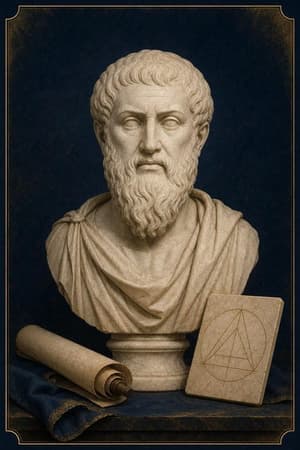
Plato
Philosophy
Quotation archive
Selected Quotes
“Education isn't what some people declare it to be, namely, the putting of knowledge into souls that lack it, like putting sight into blind eyes. Rather, the power to learn is present in everyone's soul, and the instrument with which each learns is like an eye that cannot be turned from darkness to light without the whole body being turned.”
“The blame is his who chooses. God is blameless.”
“What provides truth to the objects of knowledge and the power of knowing to the knower is the form of the good. And though it is the cause of knowledge and truth, it is also an object of knowledge.”
“Beauty itself is alone with itself, single in nature, while all the beautiful things share in it in such a way that when others come to be or pass away, it neither grows nor diminishes nor suffers any change.”
“The soul of the philosopher thinks that it must not resist this deliverance, and so it cultivates calmness and joy and smooths the way for the deliverer.”
“We should try to escape from earth to the dwelling of the gods as quickly as we can, and to escape is to become like God, so far as this is possible; and to become like God is to become righteous and holy and wise.”
“The unexamined life is not worth living for a human being.”
“And now, I said, let me show in a figure how far our nature is enlightened or unenlightened: Behold! human beings living in an underground den, and at the entrance a fire.”
“Until philosophers rule as kings or those who are now called kings and leading men genuinely and adequately philosophize, that is, until political power and philosophy entirely coincide... cities will have no rest from evils.”
“A virtue is an acquired human quality the possession and exercise of which tends to enable us to achieve those goods which are internal to practices and the lack of which effectively prevents us from achieving any such goods.”
Biography
Plato was an Athenian philosopher active in the fourth century BCE. He was associated with Socrates and later founded the Academy. His surviving works are mostly dialogues, a literary and philosophical form that complicates any attempt to treat every speaker as Plato's final position.
Historical Context
Plato wrote after Athens' defeat in the Peloponnesian War and the execution of Socrates. Questions about political disorder, education, knowledge, and the formation of character shape many of his dialogues.
Core Ideas
Plato investigates justice, knowledge, love, education, the soul, and the relation between changing appearances and more stable objects of understanding. Interpretations differ over the status and development of the theory of Forms, so careful reading requires attention to individual dialogues.
Philosophy
Plato's philosophy uses dialogue, argument, myth, and dramatic setting. Its central demand is not passive acceptance of a doctrine but sustained inquiry into what makes a life, a city, or a judgment good.
Major Works
Important dialogues include Apology, Crito, Phaedo, Symposium, Republic, Theaetetus, and Laws. The Republic is especially influential for its examination of justice, education, political order, and philosophical rule.
Influence Today
Plato remains central to debates in metaphysics, ethics, political philosophy, education, and literary form. His influence includes later Platonist traditions as well as critical responses from Aristotle to contemporary philosophy.
Sources
See the Frontmatter sources and named translation. This page avoids treating dialogue excerpts as context-free Plato quotations.
Learning Path
Part of a Structured Collection
Understanding Reality
A learning path through truth, knowledge, reality, and perception — from Plato to existential philosophy.
Continue learning path →
Understanding Yourself
A learning path through self-knowledge, identity, wisdom, and practical discernment — from Socrates to modern philosophy.
Continue learning path →
Ancient Wisdom
A learning path through foundational questions of flourishing, virtue, harmony, duty, and the art of living.
Continue learning path →
Continue Learning
Knowledge NetworkNext Step
Continue your learning path
- book
Republic
Related through Greek Philosophy
- topic
Wisdom
Related through Greek Philosophy
- thinker
Aristotle
Related through Greek Philosophy
- wisdom
Desire
Related through Greek Philosophy
- wisdom
Love
Related through Greek Philosophy
- thinker
Socrates
Related through Greek Philosophy
- answer
What Is Love?
Related through Greek Philosophy
- wisdom
Beauty
Related through Greek Philosophy
Archive references
Sources
- 01PlatoBy Stanford Encyclopedia of PhilosophyConsult source
- 02Plato's Ethics and Politics in The RepublicBy Stanford Encyclopedia of PhilosophyConsult source
- 03RepublicBy Plato; translated by C. D. C. ReeveIndianapolis: Hackett, 2004.
ZHAIBIAN Editorial Board reviewed
Reviewed by ZHAIBIAN AI Editorial Review · 2026-07-22