Archive navigation
Knowledge Path
Thinker
Bodhidharma: Philosophy, Zen & Legacy
Philosophy
Wisdom Concepts
Quotation archive
Selected Quotes
“Good friends, in this teaching of mine, from ancient times up to the present, all have established no-thought as the main doctrine, non-form as the substance, and non-abiding as the basis.”
“Whatever is dependently co-arisen, that is explained to be emptiness. That, being a dependent designation, is itself the middle way.”
“A special transmission outside the scriptures; no dependence on words and letters; direct pointing at the mind of man; seeing into one's nature and attaining Buddhahood.”
Biography
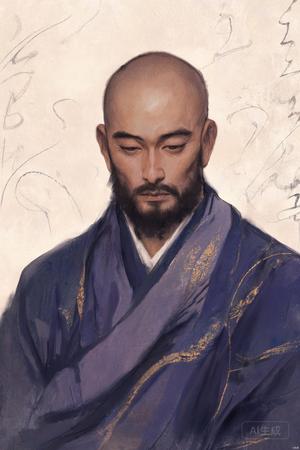
Bodhidharma is the name most people first meet when they ask where Zen comes from. He's traditionally remembered as the first patriarch of Chan, the Chinese ancestor of Japanese Zen, and the story says he sailed from India to China around the fifth or early sixth century. Here's the honest part: the historical record is thin, and most of what we "know" about him comes from later legends compiled centuries after his death. Scholars treat his dates, often given as roughly 483 to 540, as traditional rather than verified. That doesn't make him unimportant — it just means we should read the legends for what they teach, not as a biography in the modern sense.
Historical Background
Bodhidharma arrived in China at a moment when Buddhism was already settling in and translating Indian texts into Chinese. Against that background, he's credited with pushing a different direction: don't get lost in the texts, sit down and look directly at your own mind. The famous image of him facing a wall in silent meditation — sometimes said to be nine years — captures the spirit of the movement he supposedly founded. Whether the details are true or not, the stance is real, and it became the seed of a tradition that would eventually spread across East Asia as Chan and then Zen.
Core Ideas
If you had to boil Bodhidharma down to one insight, it's that awakening isn't something you accumulate from outside. He's linked with the idea of "pointing directly to the mind" and seeing your own nature, rather than leaning on doctrine or clever argument. The practice that goes with it is sitting meditation, quiet and steady, watching what the mind actually does. There's a famous saying tied to him about not relying on words and letters — a deliberate provocation in a tradition that wrote mountains of scripture. It's not anti-intellectualism so much as a warning that concepts can become a substitute for the real thing.
Major Works
A few short texts are attributed to Bodhidharma, most famously a pair of "Entering the Way" essays on principle and practice. They're usually read as early Chan teaching, though scholars debate how much actually comes from him rather than from later hands. The record here is careful: the archive treats these as part of the tradition that honors him, not as verified personal writings. If you want the classic Chan text that most clearly carries his spirit forward, the Platform Sutra is the place to go.
Philosophical Influence
Whatever the historical facts, Bodhidharma's legacy is enormous. Chan Buddhism grew up in the shadow of his legend, and Japanese Zen — think of Dogen and the Rinzai and Soto schools — traces its lineage straight back to him. The emphasis on meditation, on direct experience over book learning, and on a teacher who can point you back to your own mind all descend from this tradition. He gave Buddhism in East Asia a distinctive flavor: intimate, practical, and a little irreverent about the trappings of scholarship.
Related Concepts
Bodhidharma's tradition sits on top of classic Mahayana ideas. The emptiness taught in the Heart Sutra is the philosophical backdrop, even if Chan tends to prefer silence to explanation. The practice of sitting, what's now called zazen, is the direct descendant of his wall-gazing. And the ideal of seeing your own nature connects to the bodhisattva path, since the point of awakening in Mahayana is never just your own relief but the welfare of everyone. Read the Platform Sutra and the Heart Sutra side by side and you'll feel both the doctrine and the shift toward direct experience that Bodhidharma represents.
Sources
See the source records in the Frontmatter. This page avoids assigning unverified sayings to Bodhidharma and treats the legendary material with scholarly care.
Continue Learning
Knowledge NetworkDeep Dive
Explore related concepts
- answer
What Is Zazen?
Related through Zen
- collection
Eastern Philosophy
Related through Zen
- quote
Bodhidharma on Seeing Nature: A Flash of Wisdom
Related through Zen
- thinker
Dogen
Related through Zen
- topic
Mindfulness
Related through Zen
- book
Platform Sutra
Related through Zen
- collection
Zen Wisdom
Related through Zen
- book
Heart Sutra
Related through Zen
Archive references
Sources
- 01Buddhism-ChanBy Stanford Encyclopedia of PhilosophyConsult source
- 02BuddhismBy Stanford Encyclopedia of PhilosophyConsult source
- 03Zen BuddhismBy Internet Encyclopedia of PhilosophyConsult source
- 04The Platform Sutra of the Sixth PatriarchBy translated by Philip B. YampolskyNew York: Columbia University Press, 1967.
ZHAIBIAN Editorial Board reviewed
Reviewed by ZHAIBIAN AI Editorial Review · 2026-08-08